Wednesday, 4 January 2017

Analysis of other AS media thrillers

Blanc
The opening titles of the AS thriller opening 'Blanc' were not very eye catching or effective to the audience. The group used small black underlined titles, which made it increasingly harder for the audience to read. This distracts the audience from the tension building non-diegetic background music, as they would be focusing more on reading the writing on the screen. Secondly, I  also noticed that the long shot of the first scene is in a well-lit area, making it less thrilling as more people are likely to be scared of the dark. However, there was a subtle use of props that suggests something bad is going to happen, this is shown by sharp barbed wire being wrapped around a nearby tree- perhaps suggesting this is an area people should not trespass, as barbed wire usually symbolises places such as prisons, in which its purpose is to keep the dangerous prisoners from escaping. To improve this opening scene, the students could of employed a better and more catching background image so that the font of the writing appears more clear to the audience. In contrast, the students show a good use of editing skills by enabling the writing to come out of the trees. This is more effective than using a simple/typical fade technique. I would like my group and I to consider this use of editing as it is unique and would intrigue the audience.
 A common use of the camera within a thriller is using a handheld device. This was incorporated within the first scene and was effective as it usually exempts the characters fear by showing their shaky-hand. However, the climax had not yet built within the story so using a hand-held device wasn't as effective as it would be if the character was being chased. Additionally, the scene is a close-up shot that focuses on the floor, this is ineffective as it doesn't build tension and isn't appealing or exciting. To improve, they could of taken a long shot on the hand-held device of the boys empty surroundings, which would suggest he is alone and therefore vulnerable. Another factor that they could of improved was their use of mise-en-scene, the 'victim' is dressed in all black clothing, similar to his stalker. This ruins the tension as it makes the audience feel as if both characters are bad and possess the same qualities, meaning they would feel no fear or worrisome for the boy. 
A long shot is then adopted to show the stalker coming from behind the tree. This is a good technique as it's similar to the titles of the thriller appearing in the same way, therefore suggesting that the 'thrilling' is about to begin. With the use of props, the AS group use a mask to make the stalker look ambiguous and scary, this suggests he is a stranger and would feel no emotional connection or remorse towards the boy and will therefore do anything sinister to satisfy his sadistic needs. This is a typical convention of thrillers and sends a message to the audience that this is a bad character, thus building tension. One criticism of this however is that it is over-used and the group could of come up with a more unique plot. In contrast, the group might of chosen an already-used idea as they would know what audience it would appeal to and how to carry it out best to make it as thrilling as possible. This is something my group and I will consider doing. Additionally, the group also uses a crow bar to show that the stalker is armed and dangerous.
As the non-diegetic music increases in volume, the group adopts an extreme close-up of the victims eyes, suggesting to the audience that he is not alone in his surroundings. The boy then spots the stalker in the woods, close-up shots of the victims face show his extreme fear, which then cuts to the stalkers mask. This use of camera shots is key in a thriller as it shows the two characters are going to have a fatal confrontation. My group would like to somehow incorporate this into our thriller opening as it is a good way to build tension and cause fear and suspense. The group then uses an editing technique of slow motion to show the victim running away, this could imply to the audience that he is too slow and won't get away from the dangerous stalker. The adoption of editing is good because it shows that the group has a wide variety of skills that they are able to use to make a successful thriller.
Overall  this AS group uses good techniques such as sound, mise-en-scene, camera shots and editing to create a successful thriller opening. The story-line becomes more intriguing towards the end and provides a unique twist to other typical thrillers, making this appealing to the audience. Things that they could improve on would be a better choice of costume for the victim to make him look vulnerable, better lighting to create a more thrilling atmosphere and a more effective font to open the thriller.

Inner Evil
The opening titles of 'Inner Evil', filmed by an AS media group, are quite long and involve a lot of logos and writing. Most members of the audience would most than likely not pay attention to this, therefore it is unnecessarily time consuming. However, this does give the audience an idea of what kind of thriller it's going to be about due to the previous movies LionsGate has released. My group and I would like to consider doing this as it sets the mood for the movie. During the titles, the group uses non-diagetic sound to create suspense and give the audience an idea that the opening is going to be unusual, ambiguous and perhaps scary. The titles of the film are clear and written in thin capital letters, therefore making it easy for the audience to read. Using a clear font is good because the audience would be more intrigued to read them, which could be an important factor to help them understand the story line.
The opening scene begins with what seems to be a murder scene, the group uses a handheld device to film the girls lifeless body on the concrete floor. The use of a dolly shot is significant within a thriller as I feel it makes the events more realistic to the reader. As well as this, crime is one of most watched genre's of thriller movies as the audience are always intrigue to find out what has happened and why. A close-up shot of the lifeless girls face looking at the camera is then employed, this is really effective because it creates a connection between the audience and character,making them want to find out how she died. A close-up shot is then employed again to show the same girl awakening from a dream, telling the audience that this didn't happened. The girls facial expression still seems worried and scared, as if she knows this may be her future, therefore, this continues the suspense throughout the thriller.
The group uses the diegetic sound of heavy breathing, showing that the girl continues to be scared. With the use of editing, the group also employs quick cuts which brings a sense of edge to the thriller as they audience doesn't know what it going to come up on the screen next. In regards to the mise-en-scene, the group employs a key as their main prop. Although this is simple, the key plays a vital role within the thriller as it relates to a flashback or vision of her throat being slit by an unknown individual or entity. As well as this, the girls costume is casual and basic, making the audience wonder why she would be targeted for this crime.This coheres to the conventions of a crime thriller, as it's usually an innocent/unknown civilian that is the victim. 
With the use of editing, the group adopts slow motion to show that someone is walking behind the girl as she walks through the streets. This is an effective technique as it creates suspense for the audience. A slow motion effect could perhaps suggest that the 'thing' following her is not human. This links back to the title of the thriller 'Inner Evil'. This title causes questions for the audience as they begin to wonder if it is perhaps the girl herself that is haunting her, this is a typical convention of a psychological thriller as it reflects real life mental issues such as split personality disorder, depression, anxiety and Bipolar. As the thriller continued, I noticed that the non-diegetic sound had sci-fi aspects to it, such as a noise a robot would make. This also makes the audience question the title, as perhaps this is something extra terrestrial. 
To finish the thriller, the group uses a long shot of the girl walking a long a pathway,she is then seen to be followed by another individual, who looks like another girl. The other individuals costume is all black, this use of mise-en-scene suggests to the audience that this is a bad person/villain/antagonist. It's clear through the use of a behind the shoulder shot that the victim is being followed by this unknown person. This builds tension as it suggests to the audience that something bad is going to happen, such as a murder or further stalking. A close-up shot is then employed to show the antagonists face, it appears to be the same face of the victim. A change in the non-diegetic sound creates increasing suspense as the stalker begins to grin with an evil expression on her face. The stalker then walks out of the shot, showing the audience that this person is unstoppable and dangerous. This is a typical convention of a crime/psychological thriller opening, as this is when they feel their most powerful within the movie.

Overall, the group has used some unique techniques to make the thriller interesting for the audience. From watching this thriller I have decided that I want to include some aspects  of it  into my groups. For instance, the clear titles are effective as the reader is then aware of what's taking place, the constant sound is an important factor in maintaining the suspense and the use of camera shots and editing is useful due to it building a relationship between the audience and character. However, to improve this thriller I would have cut down the opening titles as this isn't as important factor of the thriller. Secondly, I would of had a change in the non-diegtic sound. Although it creates constant suspense, it meant there was no exciting build up to the climax.


Saturday, 3 December 2016

Conventions of a thriller movie: The Black Swan

Analysis of a thriller
The American psychological thriller-horror, The Black Swan, directed by Darren Aronofsky, was released in 2010 and starred Mila Kunis, Vincent Cassel and Natalie Portman. The plot is based on the production of Tchaikovsky's Swan Lake ballet performance. 
The opening of the movie uses non-diegetic sounds to create the ambiguous atmosphere for the audience. The opening scene incorporates a close-up camera shot of a female with manicured nails, drawing on a white piece of paper with black chalk. This contrast in colours and close-up shot/high camera angle could have been used as a metaphor for the audience. This scene is paired with non-diagetic sounds which plays the song "Swan Lake". Slowly throughout the scene, the tempo of the music fastens, which creates a tense atmosphere. As the music fastens, the girl starts to put more pressure on the chalk; which ultimately ends in the paper turning black. The title then spells "The Black Swan" in bold white letters. The use of white is perhaps used to imply to the audience that Nina, the main character, starts out innocent at the start of the movie, but then begins her tortured journey as a paranoid schizophrenic.
This use of camera angles, sounds and props could be used to give a brief hint of the narrative to the audience. For instance, the black chalk being held by a well-maintained hand that slowly begins to apply more pressure to the paper, could be used to symbolise how the actress, Nina, is losing her mind; therefore subliminally exemplifying her unstable mental-state. Reflecting the characters frantic emotions creates a dense atmosphere for the audience and sets the mood for the rest of the movie. 
In one particular scene, the audience is finally able to see Nina's utter madness through the use of mise-en-scene. She is costumed in an all black-feathered tutu and a crown that covers her face with black netting. This dark colour is a typical convention of a thriller as it suggests negativity, loneliness and evil. The next use of mise-en-scene is through Nina's makeup. The actresses white face-paint and dark eyes make the audience feel on-edge and almost scared of the character, due to her fierce movements that overall contrast usual delicate ballet performances. Her black eye makeup creates a sense of ambiguity, where although the audience knows who she is, it's as if she becomes a complete different person or entity. This theme is complimented through the use of props such as red contact lenses, is not a common prop that a sane person would wear. It almost suggests stress, anger and tiredness, which ultimately creates a connection between the audience and the character, as they begin to comprehend what devotion Nina put in to be able to play the lead role as 'The Black Swan'. In addition, the red eyes could also imply she is turning into something demonic, however this is in her imagination; overall thrilling the audience rather than scaring them. 
Within the same scene, the mise-en-scene is complimented through the use of non-diagetic sound. As Nina dominates the stage, the audience is able to hear the sound of large wings moving through the air as Nina simultaneously moves her arms in a swan-like way. This makes the performance seem realistic. Although this could be perceived as non-diagetic, some could argue that Nina, in fact, hears this noise too; implying she truly believes she is transitioning into the 'black swan' and is therefore mentally unstable. As the scene comes to an end, Nina begins to grow feathers that pierce through her skin. However, her face seems overwhelmed with joy that such a thing has taken place. This creates suspense, tension and shock for the audience and they may also feel a connection with the paranoid schizophrenic's imagination. This is due to the diagetic sound that continuously get's louder, making the audience feel en-captured to what's taking place; inevitably clearing their own thoughts and beliefs in order to tune into Nina's. This is paired with constant cuts with the use of editing, which disorientates the audiences due to the various changing scenes.
Before the movie ends, Nina goes back to her dressing room to find her enemy, who's played by Mila Kunis. A close-up shot is used to show how Nina walks in crying in a white costume. This use of camera angles and mise-en-sene pairs well together because it shows the questionable and brief innocence of the character she plays, due to white signifying purity and tears showing weakness and vulnerability. Nina's rivalry is shown through a 180 degree rule- behind the shoulder shot, which shows Nina's point of view. This use of editing is key for thrillers because it gives the constant sense of someone watching, which manifests tension for the audience. The dialogue is used to show how Mila threatens Nina by telling her she's going to take her lead role as the black swan. In response to this, Nina strangles and stabs Mila with a shard of glass that is left from the shattered mirror. A low angle shot is used to show how Nina is looking down on Mila whilst she strangles her, this is effective to the audience as it shows the dominance of Nina's alternate personality. Through the use of props, Nina's eyes begin to turn red to express her anger to the audience. This demonic approach cohere's to the thriller genre as it excites, yet scares the audience.
The final scene is of Nina in her final performance as 'The Black Swan'. This scene is extremely important in expressing the thriller genre to the audience as it shows Nina's now demolished mental stability. With the use of mise-en-scene, she starts in a white feathered costume which suggests her now declining, yet still innocent personality. With the use of constant editing through quick cuts, the audience once again would feel disoriented, this is a good technique as it reflects Nina's own disorientated mind. The diagetic sound of the song "Swan Lake" becomes increasingly louder and more daunting. This is paired with the use of red lighting that hits Nina every few seconds, this use of mise-en-scene lighting could show how she switches from sane to insane within seconds, as red is normally perceived as a negative colour. This could also be Nina's way of expressing blood to the audience, as she had just stabbed her rivalry. The finale of the performance ends with an extreme close-up of Nina's face. Her makeup has smeared down her face due to crying, yet she is holding her head high. The use of white spot-lighting could of been used to show how the character was finally free from her paranoid mind as she has perfectly completed her performance. A low angle is then used to show how the dancers crowed around her. In this shot, the audience spots Nina's rivalry, Mila. A high angle shot is then used to show blood seeking through Nina's white costume, it's then clear to the audience that she had stabbed herself instead of Mila in one of her paranoid schizophrenic episodes before the last show. 
It's then suggested that Nina dies, due to the transition of the fading spotlights above her. Although this creates a suspension for the audience, there is also a sense of relief. As if Nina is finally free. From this movie, it's clear that typical thriller conventions are used such as  dark costumes, dark lighting, intriguing props, quick cuts and camera angles and shots to show facial expressions and their surroundings. This overall came together to thrill the audience.


Friday, 2 December 2016

Analysis of an action thriller opening: James Bond- Skyfall

James Bond- Skyfall
Skyfall is the 23rd James Bond film produced by Eon Productions and released in 2012. It features Daniel Craig in his third performance as James Bond, and Javier Bardem as Raoul Silva, the film's villain. It was directed by Sam Mendes and written by Neal Purvis, Robert Wade and John Logan, and features an Academy Award-winning theme, sung by Adele. It was distributed by Metro-Goldwyn-Mayer (MGM) and Columbia Pictures.
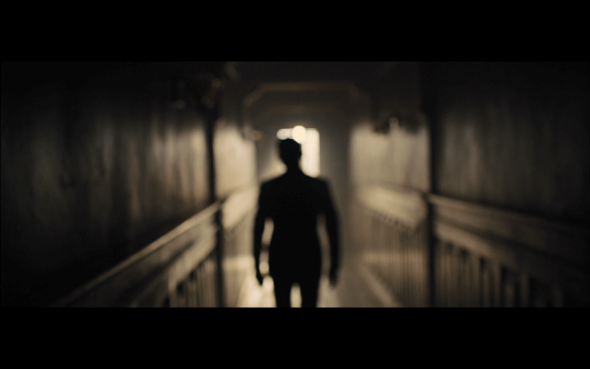
To open the scene, the directors adopt a few seconds of the James Bond theme song, therefore suggesting to the audience that Bond is present in the room. Sam Mendes uses low lighting through the use of mise-en-scene, to make Bonds figure seem ambiguous. This is also done via a long-shot down a hallway, that's taken through a blurred lens. This is effective because it draws interest and attention to the main character. One typical convention of an action thriller is low key lighting as it makes the audience feel on edge, which is something that the genre aims for. As Bond walks closer towards the camera, Mendes uses the mise-en-scene once again by brightening the lighting that hits the characters face. This suggests to the audience that Bond is someone of significance, and the audience should pay attention to him. 
Instead of using sound to build tension, Mendes takes advantage of the complete silence, this creates suspense as the audience would be hesitantly waiting for a sudden burst of sound to occur. Another typical convention of an action thriller I saw in the first scene was the employment of a close-up shot that was focused on Bonds' face, this is used to allow the audience to see the situation from the perspective of the character, which makes them feel as though they are on the scene, and it encourages the audience to empathise with the character.
Mendes also uses mise-en-scene through the costume of the character. Bond is dressed in a smart, tailored suit, therefore implying he is someone of significance. It could also suggest that he is strong and masculine and will win against any bad guy, this is typical within an action thriller. As the scene continues, Mendes adopts a gun as a prop that Bond uses to search the dark building. This is effective because it causes tension, due to it implying Bond could walk into danger at any given time. It's also unusual for the audience to have easy access or be familiar with guns, due to the strict laws in the UK, therefore making this an exciting prop that makes Bond look increasingly masculine and aspirational. Guns are also a typical prop used within action thrillers as they promote violence, fights and crimes, all of which excite the audience and bring chaos to the scene.
As Bond walks towards a doorway, there is a sense of enigma due to it being a mystery as to what is behind the door. Mendes adopts a hand-held camera shot to makes the audience feel as if they are on the mission with Bond, this is effective as it brings the action thriller to life. Similarly to the start of the video, Mendes uses dim lighting to bring the sense that something bad is behind the door. As bond enters the room there is still complete silence, Mendes employs a mid-shot to show the audience the dead bodies that are lying on the floor. This could be an example of the mise-en-scene as the bodies are used as props to subliminally tell bring an element of suspense, surprise and anxiety, all of which are key characteristics of the action thriller genre.
As the character scans the room for signs of what happened before he arrived, Bond picks up a laptop. He is instructed to see if the hard drive is still intact, this is a common characteristic of the action thriller genre as technology is usually associated with distinguishing the good guys from the bad. It's a common convention of an action thriller for the bad guys to get a hold of a piece of information that they are not supposed to have, and it is up to the good guys to retrieve it. Within this scene, camera shots seem to be less significant and mainly focus on showing Bonds' surroundings to the audience, however, this makes them feel part of the mission. As Bond walks out of the building, fast pace music through non-diegetic sound is adopted to exemplify Bonds chaotic surroundings as he sets off to his next mission, this brings excitement to the audience.
From analysing this opening scene, I have found that all aspects of the mise-en-scene (props, lighting and costume) play important roles in the building suspense, surprise and anxiety for the audience. Additionally, I have also found that neglecting to use sound is often more effective than fast pace music. This is because it builds the tension due to the audience not knowing when something is going to happen, therefore making it a useful element of surprise.


Analysis of a superhero thriller opening: The Dark Knight

The Dark Knight
The Dark Knight is a 2008 superhero thriller film directed, produced, and co-written by Christopher Nolan. Featuring the DC Comics character Batman, the film is the second part of Nolan's The Dark Knight Trilogy and a sequel to 2005's Batman Begins, starring an ensemble cast including Christian Bale, Michael Caine, Heath Ledger, Gary Oldman, Aaron Eckhart, Maggie Gyllenhaal and Morgan Freeman.In the film, Bruce Wayne/Batman (Bale), James Gordon (Oldman) and Harvey Dent (Eckhart) form an alliance to dismantle organised crime in Gotham City, but are menaced by a criminal mastermind known as the Joker (Ledger) who seeks to undermine Batman's influence and create chaos.
To open the scene, Christopher Nolan employs an establishing aerial shot which gives the audience an idea of where the movie is going to be set. Since it pans around an area with high skyscrapers, it implies to the audience that it's taking place in a wealthy area. This could suggest, due to the genre of the film, that the bourgeoisie are going to be the victims, or perhaps they are the antagonists themselves. As well as this, Nolan employs certain aspects of mise-en-scene, such as lighting, to tell the audience that the events are taking place during the day. This is different to other thrillers, which are typically set in the dark, as it creates suspense. Non-diegetic sound then takes place which is a very eery tune produced by Hans Zimmer. This music works well with the mise-en-scene as it brings tension and suspense to the bright and happy atmosphere; ultimately suggesting something bad is going to happen. As the camera gets closer towards the tall building, a glass window shatters. This use of sudden and loud diegetic sound shocks the audience as it's unexpected would make them jump, this is something to aim for in thrillers as it intrigues the audience. A behind-the- shoulder shot is then employed to show a masked man's face with a gun in his hand. 
Through the use of mise-en-scene, Nolan uses props, such as an ambiguous mask and a weapon, to tell the audience that this is a bad person/villain. Ultimately, this suggests to the audience that something bad is going to happen, this also coheres to the superhero thriller genre. Through editing techniques, Nolan adopts quick cuts between different shots to show that events are happening quickly to do with the masked men, this could perhaps suggest they are on a mission in the wealthy city and creates excitement for the audience. Nolan zooms in slowly from a mid-shot to a close-up of a man holding the familiar villain mask in his hand, he then gets into a car abruptly. Nolan creates increasing tension and suspense within the film opening by using quick cuts, mise-en-scene and sound. 
Due to the film being about the never-ending conflict between the Joker and Batman, Nolan uses the clown masks to help the audience distinguish between the good and bad people. This is because the Joker always wears messy makeup on his face. This is also a good technique as a lot of individuals in the audience would be scared of clowns, making the joker seem sadistic enough to try and scare people with his appearance to get a thrill, inevitably, this cohere's to the superhero thriller genre. The dialogue within the next scene works well with the mise-en-scene, as the villains are heard talking about their share of money and who can shoot who. This increases the tension as it sounds like a bank robbery is going to take place, making this a typical convention of the general thriller genre; crime. Nolan adopts a long-shot of the villain's surroundings within a bank. A dolly shot is also employed to move along quickly with the actors, this gives the audience a sense of chaos. Diegetic sound is then employed via gunshots and people screaming. The camera then cuts to close-up shots of the individuals faces in the bank to express their fear to the audience, which suggests to them that something bad is happening. Behind the shoulder shots are used to show how the villains hold up guns to the bank workers faces, this use of camera positioning almost makes the villains look faceless and emotionless, meaning they lack remorse and will do anything to finish their mission. This is a common stereotype of a villain and compliments the genre nicely.
Another technique that was adopted was a hand-held device. Commonly used in thrillers, this use of the camera brings shakiness to the screen, making it look like it's coming from a real person perspective who is present in the room. Because of this, the audience would feel as if they are also there, shaking from the fear of being shot. This is a good technique to build tension as it makes the events seem more realistic for the audience. This is important to create within a thriller as it keeps the scene exciting and thrilling.
Overall, Christopher Nolan employs common techniques used within the thriller genre to ultimately build suspense and intrigue the audience. Some of these techniques include mise-en-scene through props and lighting, camera shots and sound.

Analysis of a horror thriller opening: Saw

SAW
https://www.youtube.com/watch?v=6F2tFCiqOmw
Saw is an American horror franchise distributed by Lions Gate Entertainment and produced by Twisted Pictures that consists of seven feature films and additional media. Saw: Legacy is an upcoming American horror film directed by Michael and Peter Spierig, and written by Josh Stolberg and Pete Goldfinger. It is the eighth instalment in the Saw franchise.
 In the opening of the movie, a man is seen laying on a hard, concrete floor. With the use of mise-en-scene, Spierg makes the lighting of the room extremely dim. This sets the mood for the movie for the audience as dark lighting is typically used in horror-thrillers as it puts the audience on edge and creates a sense of ambiguity. For instance, they don't know what is going to suddenly scare them. Another use of mise-en-scene is via the costume of the character. The confused man on the floor is dressed in casual clothing. However, they are ripped and dirty. This makes it clear to the audience that he doesn't know how he got to that location. This could subconsciously be suggesting to the audience that the character was kidnapped and is there against his will. This referencing to crime is a typical convention of a thriller as this is a good fear factor to engage the audience. With the use of transition shots, the opening scene switches from showing the character, to fading to black to show the opening titles. This use of editing is useful because the titles are sharp and the background is black, meaning it also sets a thriller/horror atmosphere for the audience as dark colours are often interoperated as sinister or imply danger. By employing deep and mysterious non-diegetic sound, the director is able to create tension and suspense. This is a common technique used to build the atmosphere in a thriller as it attracts the audiences undivided attention.
A long shot is then employed to give the audience an idea of the location in which the scenes are filmed in. Within this shot, the audience automatically identifies three dead bodies that are scattered around the room like casual decoration. This coheres to the thriller genre as it's usually closely related to crime, such as murder; this is one of the most typical conventions of a thriller as the audiences feel increasingly interested in the story line. This use of these props also shocks the audience as they then know that something bad is going to happen, this is paired with the use of a close-up shot that shows how the victim is chained to the wall, making him vulnerable and helpless. In the long shot, the audience also identifies a man who is standing  above the victim. With the use of mise-en-scene, the director uses costume to make this man seem powerful and dangerous. For instance, he is costumed in all black clothing which is typically a dominant colour and is similar to the dark thriller titles, these paired together suggests to the audience that this man is the perpetrator in the movie. Thriller movies usually incorporate a perpetrator as its a typical convention of the genre due to it giving the audience a suspect. This intrigues them and would encourage them to watch more. As well as this, Spierig incorporates a 'saw' as a prop. This weapon is shown in a long shot which captures the weapon being thrown across the floor, ultimately implying that the victim has no way of breaking the chain; thus once again making him vulnerable and helpless.
With the use of dialogue, the director prompts the victim character to use constant profanity towards the perpetrator, implying he is frustrated and scared and therefore tries to mask this by expressing dominance through his speech. This is a good way to open a thriller to the audience as it gives them their first hint of the storyline, where the victim will loose no matter what as words are useless. It reflects real life societal problems such as murder and torture, thus thrilling the audience as they are able to comprehend the seriousness and surrealism of the characters situation and their likely fate of death. Intriguingly, Spierig uses a walking stick to make the perpetrator seem weaker than expected. This prop, shown in a long shot, is new to the audience and surprisingly goes against the typical conventions of a thriller as it makes the character seem just as vulnerable as the victim. As he limps across the dingy room, the perpetrator is again shown in a long shot, turning off the lights. A close-up shot is then adopted to express the victims fear and frustration after being abandoned with no recourses for survival. When the scene ends, the perpetrator adopts dialogue by saying "Game Over" as he closes the door, which ultimately leads to blackness. These words suggest to the audience that the victim is going to die, however, the ambiguity still lingers as they are confused about why he is there, how he will die or even how will he escape the 'game'. This creates a similarity between this and other thriller movies as the darkness almost shapes/suggests the frightening, yet ambiguous, fate. 
Through all of these factors, the director is able to give the audience an idea of what the thriller will consist of by employing common themes such as crime, darkness and ambiguity. 

Monday, 14 November 2016

Analysing three moments of suspense in a thriller

The Sixth Sense is a 1999 American supernatural horror-thriller film written and directed by M. Night Shyamalan. The film tells the story of Cole Sear (Haley Joel Osment), a troubled, isolated boy who is able to see and talk to the dead, and an equally troubled child psychologist (Bruce Willis) who tries to help him. The film established Shyamalan as a writer and director and introduced the cinema public to his traits, most notably his affinity for surprise endings. Throughout the movie, there were three main moments/scenes of suspense that shocked and thrilled the audience. The first scene I will analyse was at the beginning of the movie. A husband and wife go into their room to find that their window had been smashed, and there was in intruder in their house. 
The intense scene begins with the couple walking into their room. With the use of mise-en-scene, Shyamalan dims the lighting of the room so it looks dark and scary. This is a typical convention used in thrillers as it sets a sinister atmosphere. The low-key lighting within this scene highlights the character and also creates shadows on the surfaces behind them. Although a shadow is harmless, this is a typical technique used as it makes the audience feel as if there is something following or watching them at all times. Suddenly, the atmosphere becomes tense and suspense builds due to the use of diegetic sound, which was adopted for the audience to hear the wind howling and the broken glass cracking as they walk slowly across it. A high-angle shot is paired with this to capture the broken glass and other destruction that was caused by the break-in. Although this is not demonic or horrifying, it does reflect a terrifying realistic situation that could easily happen to anyone in the audience, therefore setting the daunting and 'thrilling' atmosphere. A mid-shot is then used to show the two characters facing the opposite direction to the camera. A black shadow then crosses them, showing the audience there is someone or something else present in their home.With the use of editing, the scene then cuts to a close-up camera shot of the couples distressed faces. Shyamalan uses diegetic sound through the wife screaming. This simple reaction causes tension for the audience as this expresses the characters utter fear and weakness. To pair with the diegetic sound, mise-en-scene is used through the characters costume. The female is in a dress that exposes her arms and chest, she is also wearing minimal makeup. This was presumably employed to reflect typical 'girly' stereotypes of a woman, which manifests her vulnerability. This is a typical convention for a thriller as it suggests something bad is going to happen due to her weakness.
With the use of camera shots, it's clear that the next part of the scene is shot with a hand-held device. The mid-shot captures the direction from which the shadow came from. This is also called a point of view shot as it shows the characters eye-line perspective. The shot seems to be shaky and unstable, which creates suspense and coheres to the thriller genre as it exemplifies how frightened the characters are, inevitably aiding the audience to experience the same emotions due to the atmosphere. Shyamalan uses a tracking shot to move the camera through the room, whilst the use of diegetic sound creates an eerie atmosphere as the character walks on the broken glass to find the intruder. The director then finally employs a creepy non-diegetic music, which begins when a mid-shot of the intruder appears on the screen. Through the use of mise-en-scene, the intruder's costume is plain, dirty underwear. The character is seen hunched over with a confused look on his face. The husband is seen with a distraught and petrified facial expression as he realises what danger they are in. With the use of the thrilling diegetic sound, mid-shot and mise-en-scene, the director was able to communicate to the audience that this intruder is dangerous, mad and almost wild-like through his lack of clothing. This inevitably creates suspense as it gives an ambiguous ending to the audience.
With the use of a close-up, the intruder is seen to pace towards to door-opening, his face appears distraught, which automatically sends a message to the audience that he is not mentally stable and is harmful. Another close-up is then used to show the husband moving backwards, and the females horrified facial expression. The husband explains that there are no prescription drugs in the house through the use of dialogue, showing the audience that this intruder is perhaps schizophrenic and is unable to think rationally. The non-diegetic music begins to get increasingly louder as the intruder starts to raise his voice, accusing the husband/doctor of not curing him of his mental problems. It appears that a subtle hint of white makeup has been used to make the intruder look washed-out, even ghostly. This use of mise-en-scene is effective because it shocks the audience, making them feel almost paralysed in fear as if something non-human is directly addressing them through the screen. Close-up camera shots are used to pan across the intruder's and husband/doctors face, to show how they are the main focuses in this scene. With the use of dialogue, the intruder addresses the doctor as 'hero' in a sarcastic manner, which suggests to the audience that this scene will end badly as it reflects a hero vs villain type complex; in which only one can win. To contrast their good and evil personalities, the director uses a cut-away to exemplify the difference between the calm 'heroes' face and the unstable 'villains' face, to ultimately make the audience feel on-edge. Through diegetic sound, the intruder then bangs on the door to express his anger and pain. This creates suspense because the audience will question whether he will take these violent out-bursts even further.
As the scene ends, the audience is startled by the intruder's reaction to the doctor's sympathy. The suspense comes to a sudden stop as the intruder picked up a gun and fired at the unarmed husband/doctor. This use of props almost shows the intruders weakness, by using a powerful weapon instead of putting up a fight or facing his problems by listening to the doctor. This sudden rush of suspense shocks the audience and coheres to the typical thriller genre as it kept them on the edge of their seat. This was due to eerie diegetic and non-diegetic sound, contrasting mise-en-scenes in regards to clothing, camera angles/shots and editing.

Second moment of suspense
https://www.youtube.com/watch?v=Vc5B-ercdKE
The second moment of suspense starred the main character of the movie, Cole Sear. In this scene, Cole debates whether he should go to the bathroom in the middle of the night. To the audience, this seems like a harmless action. However, to Cole, this is dangerous. Shyamalan uses firstly uses a close-up shot of Cole, who is poking his head slightly out of the door. This shot has quite a long duration, which suggests to the audience that the character is contemplating whether this is worth the risk. This creates suspense for the audience because they would be intrigued, yet frightened, to find out why Cole does not want to leave the safety of his room. During this camera shot, there is no sound. This is effective because it's eerie and often silence is more daunting than typical thriller music choices. The director uses a dark lighting through the use of mise-en-scene to show the audience that this is occurring at night. It's a known fact that individuals are more likely to be scared of the dark, in fear of what may be lurking around that they can't see. This typical thriller convention creates suspense as the audience is more likely to be scared of what may appear from the shadows. 
The director employs the use of quick editing cuts, to switch to a long shot of the small boy standing at the bottom of a large, long and dark hallway. This could have been used to signify his vulnerability and innocence in compared to his surroundings. These typical stereotypes of young people make the audience feel edgy, as they are worried about what might happen to the small boy. As well as this, the director uses a typical costume choice consisting of a small white vest and boxers. This use of mise-en-scene aids in the perception of Cole as a young boy, as this is typically what mothers dress their young boys into wear to bed as pyjamas. With the use of diegetic sound, the director adds in the noise of a door squeaking as it slowly opens when the boy begins to run to the bathroom. This use of sound is effective and is also typical of a thriller movie as it breaks the silence and is eerie due to its high pitch.
When Cole reaches the bathroom, he is facing in the opposite direction to the camera. The director uses a long shot to include the long hallway into the shot. It's clear to the audience that something bad is about to occur, as this long shot implies that something is going to walk behind Cole. This is a great way to encourage the build up of suspense because the audience knows that the shot is far enough in order for the focus to not only be of the main character but also on something else that is far less 'innocent' or 'vulnerable'. Suddenly, the scene cuts to a close-up shot of a thermometer, which shows the declining temperature of the dark house. This creates a hostile atmosphere as it's as if something demonic or supernatural is present, this is due to ghost stories usually having something to do with a declining temperature. To aid in this build up of suspense, Shyamalan employs non-diegetic sound which is extremely eerie, it increases in volume which makes the audience feel more patronised. Suddenly, a woman walks across the camera directly behind Cole. As this happens, a loud bang startles the audience to let them know that this is not a welcoming presence. The camera cuts to a close-up of Cole's head, which slowly turns towards the camera as he senses the negative presence. The non-diegetic sound then uses a different type of instrument, that is loud and high-pitched; automatically paralysing the audience with fear. All of these factors created suspense as they worked together to build up to the main, thrilling, ending.
Once Cole's face turns towards the camera, the non-diegetic sound continues and increases in volume. Through the use of special effects in editing, Cole's heavy breathing becomes apparent due to the condensation that occurs once it leaves his trembling mouth. The same long-shot is then used to capture Cole, paralysed with fear. The use of the long-shot belittles him as it makes him look small against his surroundings. The audience feels connected to the boy as they almost understand what he is experiencing due to the realistic suspension. Similar to the first scene I analysed, the director uses a long shot of the hallway that is walked down with a hand-held device. The camera slowly moves towards the location of the entity. The shakiness of the camera creates tension and suspension for the audience because it brings the scene to life and makes it seem as realistic as possible. For instance, it suggests the idea that Cole is shaking, this builds tension because it encourages the audience to react in the same way. The adoption of a point of view shot is also useful because it makes the audience feel as if they are the one in the movie and the camera shot is in their own eyes.
Overall, the director has used these different techniques and conventions to make Cole seem weak and vulnerable to the powerful, unwelcome, presence. For example, Shyamalan  employs mise-en-scene to make Cole look young and vulnerable, he uses sound techniques such as diegetic and non-diegetic to build suspense and the director also use's editing and camera shots to add realism to each shot and make it thrilling and shocking for the audiences entertainment.
Later on in the movie, Cole has one particular encounter with something paranormal that stands out to the audience and causes tension and suspense. The scene begins in a house that is unfamiliar to Cole and to the audience. He is at a birthday party. As he sits by himself, a red balloon catches his attention. The character watches this mysterious balloon float all up the long, spiral stairwell and disappear. Intrigued, Cole follows it.
The first hint of suspense is when a medium close-up is used to show that Cole is alone. The camera slowly pans towards him, which looks as if something is following or moving towards him. As well as this, it also captures Cole's shadow. This is similar to the technique used in the first scene I analysed as it makes the audience feel as if there is something else present in the room. Another way in which the director makes Cole look isolated and vulnerable, is through a shallow-focus shot. This is because it blurs out his surroundings, making it appear that there is perhaps no one around to protect him. This creates suspense as the audience is then aware that something bad may happen, in which no one will be able to save Cole. Once the panning stops, a close up shot is used to capture Cole's face as he looks up above him. Although the shot cuts quickly, this creates suspense as the audience becomes paranoid to see what has caught Cole's attention. The screen then switches to a long shot the red balloon. It's at first still, but once Cole pays attention to it, it begins to move. Shyamalan may have employed this technique to make it seem as if something is trying to lure Cole to an isolated area, where he is inferior and weak.
 As Cole makes his way up the stairs, the director uses a mid-shot to capture his shadow on the wall in front of him. Through the use of mise-en-scene, the lighting of the room appears dark and scary, as well as this, the music in the up-beat background from the party begins to decrease in volume. These techniques paired together are perhaps used to suggest to the audience that he is getting closer to danger. The lighting and camera shots show this well as Cole's shadow is creepy and looks almost as if a spirit is leading him up the stairs. The use of the fading diegetic sound causes suspension, as it strips the scene from the happier, more pleasant atmosphere that was created from the comfort of the busy party. Once Cole reaches the top of the stairs, the continuous use of diegetic sound is employed that sounds like a man whispering to himself. As Cole gets further up, the use of a medium close-up shows an image of a small, open door. Inside the door is nothing but darkness. With the additional diegetic sound, the audience is made to think that the voice is coming from the small dark room. The voice then becomes increasingly louder, demonic and hostile towards Cole. The voice yells 'open this door or i'll break through it and grab you'. As well as this dialogue, Shyamalan also uses background music in the form of non-diegetic sound, it's eerie and creates a dense, tension filled atmosphere for the audience. Another factor that creates tension, is that the aggressive voice says it is going to 'break through' if he doesn't open it, however the door is already open. This suggests to the reader that the person yelling is delirious as he seems to think he's trapped. 
Shyamalan uses a close-up shot of Cole's face to exemplify his fear to the audience, thus creating tension as the audience feels as if they are in the same situation. Cole is then confronted by two boys of his age, who lock him in the dark and scary room as a joke. Little do they know, there is someone already waiting for the boy. Cole knows the danger of this and begins to scream. The director uses dialogue and loud bangs that come from Cole, pleading the boys to let him out. However, Cole's screaming comes to a sudden stop and is replaced with the diegetic sound of him pushing his body close to the door, as if he has realised he is not alone in the confined space. To break the silence, the diegetic sound of the red balloon popping frightens the audience as it's unexpected. Straight after the loud bang, Cole begins to scream. With the use of editing, short shot duration's are adopted to show how Cole's mother comes to his rescue. The use of the quick cuts expresses the mothers fear and panic as he rushes up the stairs to save him. This causes suspense as the audience is intrigued yet scared to find out what will happen when she opens the door for her traumatised son. However, she can't open the door. Cole's piercing screams make the mood of the scene tense and horrifying. A medium close-up of the mother trying to open the door is used to show the audience that he is for some reason trapped and can't get out. This was perhaps the entity's sadistic way of explaining to the audience that he is also trapped.The idea of a paranormal presence creates suspense, as it's something the audience would feel submissive and inferior to, meaning they would more likely be frightened. 
To end the scene, the door finally unlocks and Cole is carried out by his mum in slow motion. The use of medium close-up causes suspense in this scenario, as the audience is now worried to find out what has happened to Cole to make him pass out in his mothers arms. This would more than likely create suspense for parents in the audience, as they would understand what it's like to care/ worry for a young child.